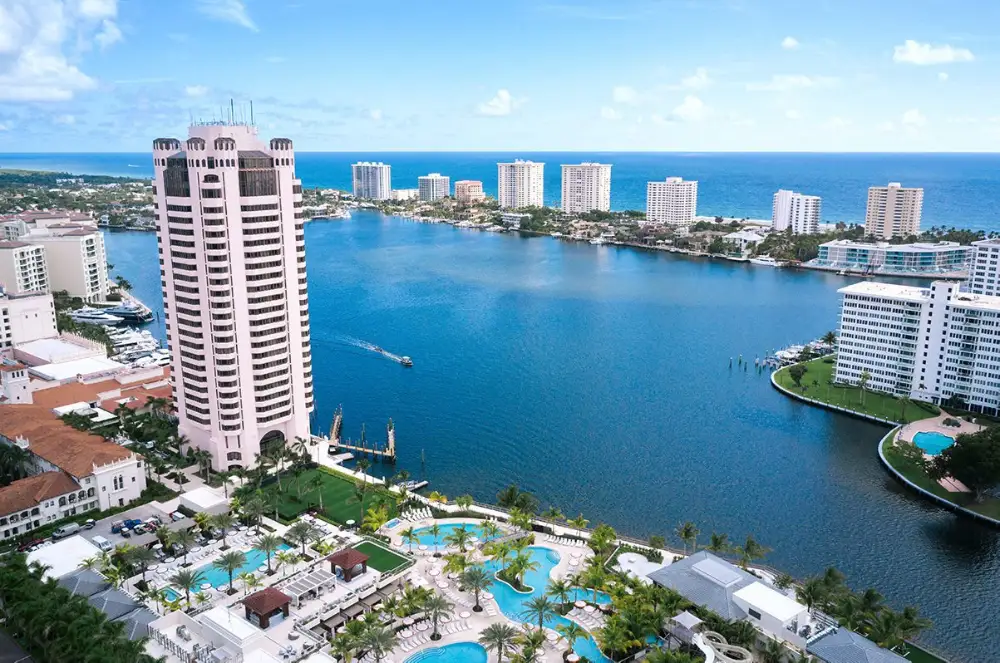
The Boca Raton Historical Society & Museum mentions that maps from the 1700s illustrate that at first, “Boca de Ratones”- a navigational term for a rocky and jagged inlet- was located in current-day Biscayne Bay in Miami Beach. Eventually, the City of “Boca Raton” was incorporated in May of 1925, where it sits on the Atlantic Coast today, north of Deerfield Beach and south of Delray Beach. Before the completion of the Florida East Coast Canal, today’s Intracoastal, and the Florida East Coast Railway, the Glades, a native tribe, were the earliest inhabitants of the area, dating back to around 1,000 years prior.
In the early 1900s, the eastern area was home to a quaint agricultural community, primarily farming pineapples. In 1904, a group of Japanese settlers led by Jo Sakai settled in Northern Boca Raton, Southern Delray Beach. This agricultural colony was named “Yamato” – a revered name in Japan. The settlement later attracts George Morikami, whose namesake and donation of over 200 acres of land makes the beautiful Morikami Museum and Japanese Gardens still attract people from all over the world today.
Addison Mizner became known as the official “town planner” within a year of Boca Raton’s incorporation in the mid-1920s. Mizner’s resume included little formal training, but an apprenticeship with prominent with Willis Polk, a significant force in the development of the city of San Francisco, and had a decade of experience working on the architect of country homes on Long Island. He was known for themes and styles reminiscent of the Mediterranean and Spanish Revival architectural look and feel.
Mizner wanted to make Boca Raton the number one resort city destination. He started the Mizner Development Company raising $5 million in stock, $500,000 set aside for the average Florida citizen. The rest sold to notable figures such as Harold Vanderbilt, the Dutchess of Sutherland, Madame Frances Aida, Paris Singer, and Irving Berlin, to name a few. He began with the city buildings. The original town hall is now home to the Boca Raton History Building. Constructed in 1926, the Ritz Carlton Cloister Inn designed by Mizner today is home to The Boca Raton Resort & Club. Sadly, most of Addison Mizner’s dreams did not reach fruition. In 1927 the Mizner Development Company went bankrupt after the Miami Hurricane of 1926 and the end of the Florida land boom.
During World War Two, land from the Yamato Colony became the Boca Raton Army Air Force Base. The base became known for training radar operators and B-29 bomber crews. Later the land was donated to one of the first public universities in the State, Florida Atlantic University, established in Boca Raton in 1961, with the first students attending in 1964. In the early 1950s, Boca Raton featured two amusement parks. Present-day Camino Gardens subdivision, Africa U.S.A. – running from 1953 to 1961, was the first open-air, no cage, wildlife attraction. The entrance to Camino Gardens showcases remnants of Africa U.S.A. such as a red wooden bridge and a 30-foot waterfall. Ancient America, the other amusement park constructed around an actual native American burial mound, ran from 1953 to 1959.
Today, residents and visitors can view the Barnhill Mound from the Boca Marina and Yacht Club on U.S. 1 near Yamato. In 1981, the first personal computer by IBM was unveiled at the Boca Raton Campus – at one point the largest employer in the city. Throughout the 1980s and 1990s, the City of Boca Raton was focused on Redevelopment. Architecturally inspired by the Mediterranean Suburban Town Center design, in 1991, Mizner Park finished construction where the old Boca Raton mall once sat.
Scroll down to peruse the gorgeous homes for sale in one of the gorgeous Boca Raton 55+ Communities. Find all you need to know in one place!
- Find out how much the HOA fees are and what they cover.
- Review association restrictions on pets and vehicles.
- Learn about the design and construction.
- Discover community amenities.
- Explore restaurants, nightlife, things to do, transportation, and hospitals in the surrounding area.